
Volume I
Issue I
2026
The Gatehouse
Friends of Woodland Cemetery Newsletter

Welcome to The Gatehouse
Over the past year, Friends of Woodland Cemetery has been busy fundraising, honoring veterans, hosting events, and finding new ways to preserve and share this place we all care about. But beyond the work itself, what matters most is why we do it: Woodland Cemetery quietly holds our community’s history in plain sight.
That feels especially meaningful this year as our nation marks the 250th anniversary of American independence. From the Revolutionary War to Vietnam—and in times of peace as well—men and women from our community have served, and some gave their lives. In this issue, you’ll find the story of how we began identifying and honoring those veterans.
While preserving history is a central part of our mission, Friends also strives to serve the living. In this issue, you’ll find reflections on coping with loss, a review of a cookbook featuring recipes carved on gravestones, a look at the growing interest in “tombstone tourism,” and the scandalous story of Judge Isaac Horton Maynard, who helped steal an election. You’ll also find information about planned giving, upcoming events, and how you can become part of Friends.
Whether you’ve been involved from the beginning or are just discovering Friends of Woodland Cemetery, we’re glad you’re here.
Barb Kopecek — Board of Directors, Friends of Woodland Cemetery
In This Issue
-
Behind Every Name:The Veterans of Woodland Cemetery
by Barb Kopecek
-
Tombstone Tourism: A Growing Grave Pastime
by Kevin Jack
-
Among Friends
This Is Going to Sound Crazy… by Daryl Kovalich
What Recipe Would You Like to Be Remembered By? by Emily Helk
-
Stories Beneath the Stones
A Delaware County Scandal: The Rise and Fall of Judge Isaac Horton Maynard by Kevin Jack
-
Tending Woodland
Planned Giving: Preservation as Legacy by Janet Schwengber
Planting for the Future by Jess Hamilton
Remembering Frank Bovee
Upcoming Events

Behind Every Name: The Veterans of Woodland Cemetery
By Barb Kopecek — Board of Directors, Friends of Woodland Cemetery
A community effort to document, preserve, and share the stories of those who served
Among those buried at Woodland are more than 700 veterans who served in nearly every major American conflict, from the Revolutionary War and War of 1812 to the Civil War, World Wars, Korea, and Vietnam. For many years, their stories existed only in fragments—scattered across records, remembered by families, or quietly honored each Memorial Day by the local Boy Scouts and American Legion.
Today, we are beginning to bring those stories together.
Building the Veterans List
Over the past year, Friends of Woodland Cemetery has been working to identify and document the veterans buried here. This effort has been made possible through the dedicated work of Kelly Durocher, the creator of Schenectady County’s Finest, an online project dedicated to preserving the stories of Schenectady County men and women who lost their lives in war.
What began as a personal journey for Kelly grew into years of research that has been recognized and used by regional organizations, including the Albany Diocese’s Cemeteries, the Capital Region Veterans Memorial, and the New York State Military Museum and Veterans Research Center.
For Woodland, Kelly drew from a wide range of sources, including military and cemetery records, historical society archives, databases like Ancestry and Find A Grave, and the extensive veterans card catalogue index compiled by former longtime Woodland Superintendent Frank Bovee.
She also used resources like the National Archives and the extensive collection of historic newspapers found on Old Fulton NY Postcards to uncover personal details about the men and women themselves. That work has helped us begin building memorial pages for those who died in conflict.
The result is a growing, organized record of Woodland veterans by conflict. It’s a powerful reminder that this small, rural cemetery is deeply connected to the broader story of our nation.
How You Can Help
While we’ve made substantial progress, this work is far from complete.
We are inviting the community to help us tell the full story of all veterans buried at Woodland through our “Honor a Veteran” initiative.
Through this project, we are creating individual tribute pages that bring together military service with the personal details that make each life unique—records that families and the community can return to for years to come.

If you have a connection to a veteran buried at Woodland, we would be honored to include their story. We welcome:
- Stories and personal recollections
- Photographs
- Details of military service
Submissions don’t need to be formal—a few sentences, an obituary, or a photo is enough to begin.
You can learn more or submit information here:
https://www.woodlandcemeterydelhi.org/honor-a-veteran-buried-at-woodland-cemetery/
You can also explore the current veterans list here:
https://www.woodlandcemeterydelhi.org/veterans/
Behind every name at Woodland is a story.
With your help, we can preserve those stories so that the veterans buried here are remembered not just for their service, but for the lives they led and the contributions they made to our community.

Tombstone Tourism: A Growing Grave Pastime
By Kevin Jack — Friend of Woodland Cemetery
“It might sound macabre, but some of the country’s best-known cemeteries are actually also havens for nature-lovers, culture-hounds and even after-dark revelers.”
Wall Street Journal, September 27, 2024
Do you enjoy exploring cemeteries, reading gravestones, and studying the art, history, and rituals associated with death and burial? If the answer is “yes,” then you might be a “taphophile.” This term comes from the Greek words “taphos” (meaning tomb) and “philia” (meaning affinity or love). Moreover, if you travel to take part in this hobby, then you are part of a growing global phenomenon called cemetery or tombstone tourism.
Growth of Dark Tourism
Dr. Susan Slocum, a professor at George Mason University, considers tombstone tourism to be a form of “dark tourism.” This encompasses visits to sites of death, disaster and human suffering in a touristic form. The popularity of dark tourism has grown in recent years; one online survey found that 82% of Americans had visited at least one dark tourism destination in their lifetime.
What catalysts are driving this growth? According to Grand View Research, “Consumers are increasingly drawn to experiences that offer a deeper understanding of history, culture, and the human condition.” They also note that visitors are “driven by a desire for meaningful and educational travel experiences, as well as the influence of media and popular culture.”
Two of the most visited dark tourism sites in the U.S. are locations associated with historical tragedies and disasters. First, the USS Arizona Memorial in Hawaii, which marks the resting place of more than 1,100 sailors and Marines killed during the Pearl Harbor attack on December 7, 1941. Second, the 9/11 Memorial & Museum in New York City, where 3,000 people died at the World Trade Center in 2001.
Other popular dark tourism sites include former prisons like Alcatraz Island in San Francisco Bay and Eastern State Penitentiary in Philadelphia. People also visit the locales of disasters like the Hindenburg crash site in New Jersey. Finally, they go to locations of historical events like the 6th Floor Museum at Dealey Plaza in Dallas, the building from which President John F. Kennedy was assassinated in 1963.
Dark tourism is also a global economic powerhouse. An August 2024 report from Grand View Research indicated that the industry, which was worth an estimated $32 billion in 2023, is on track to reach $38.6 billion by 2030.
Rise of Tombstone Tourism
Professor Slocum indicates that tombstone tourism is a relatively small part of dark tourism. While there are no statistics on cemetery tourism specifically, the evidence suggests it is a growing phenomenon, especially when you look at the number of news articles and books published recently about cemeteries.
There are many reasons why people visit cemeteries as tourists. Professor Slocum notes they may seek out personal genealogy and family connections. Or patriotism may motivate them — think of the Normandy American Cemetery in France, where more than 9,300 American soldiers who died on D-Day lie. Another goal may be to visit the graves of famous people. (John F. Kennedy and Elvis Presley receive the most visits in the U.S.) Dr. Philip Stone, the Executive Director of the Institute for Dark Tourism Research at the University of Central Lancashire in the United Kingdom, likens tombstone tourism to “sightseeing the mansions of the dead.”
Tombstone tourism is not a new phenomenon in the U.S. Up until the 19th century, prior to the establishment of public parks, people considered cemeteries as places for leisurely strolls or picnics. In Brooklyn, NYS Gov. DeWitt Clinton’s gravesite not only helped to put Green-Wood Cemetery on the map, but by 1860 the cemetery welcomed over 500,000 visitors per year. This made it the second most popular tourist attraction in all of New York State after Niagara Falls. Similarly, a 1931 article in the New York Times noted that more than 70,000 people annually visited Andersonville National Cemetery in Georgia. This house of horrors is the site of the notorious Confederate prison camp where almost 13,000 Union soldiers perished during the Civil War.
Since the 1997 release of the movie Titanic, Halifax, Nova Scotia has experienced a surge in Titanic-related tourism. The city became a popular destination for those interested in the tragedy, likely due to its role in the recovery and burial of Titanic victims. Halifax is the final resting place for 150 Titanic victims; 121 of whom rest in Fairview Cemetery. One grave marker, which only has “J. Dawson” written on it, has left many wondering if he is the model for Jack Dawson, the character played by Leonardo DiCaprio.
Most Visited Tombstone Destinations
Père Lachaise Cemetery in Paris — which houses the remains of numerous famous figures, including Jim Morrison, Frederick Chopin, Oscar Wilde and Édith Piaf — is widely considered to be the most visited cemetery in the world, attracting over 3.5 million visitors annually. With over 3 million visitors each year, Arlington National Cemetery is the most visited cemetery in the U.S. The grave of President John F. Kennedy holds first place for tourists there.
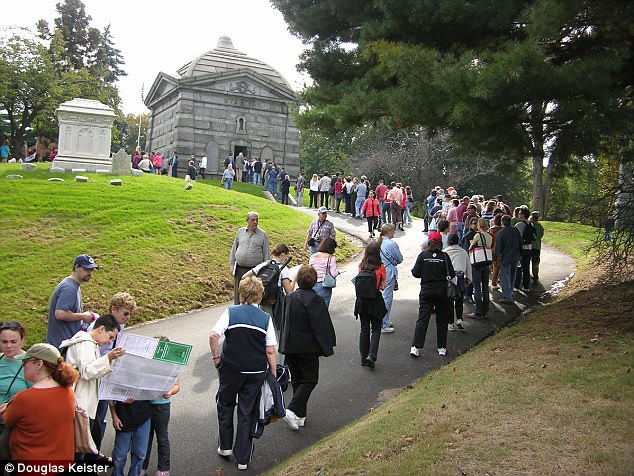
Visitors line up to see inside the Steinway Mausoleum at Green-Wood Cemetery in Brooklyn
I wondered which gravesites in New York cemeteries are among the most popular, so I conducted an unscientific poll of some of the larger cemeteries around the state, asking them about their most visited gravesites. Here are my results:
Albany Rural Cemetery (Albany):
- 21st U.S. President Chester A. Arthur
- Emma Rathbone Banks (“The Angel at the Sepulchre” sculpture)
Forest Lawn (Buffalo):
- Congresswoman Shirley Chisholm
- 13th U.S. President Millard Fillmore
- Punk-funk singer Rick James
Green-Wood (Brooklyn):
- Street artist Jean-Michel Basquiat
- Conductor-composer Leonard Bernstein
Mount Hope (Rochester):
- Women’s rights activist Susan B. Anthony
- Social reformer and abolitionist Frederick Douglass
Woodlawn (Bronx):
- Salsa singer Celia Cruz
- Jazz musicians Duke Ellington and Miles Davis
- Author Herman Melville
The gravesites of two notables buried at Woodland— General Henry Leavenworth and Undersheriff Osman Steele — are among the most visited in our cemetery. (Note: Leavenworth’s remains were moved from Woodland Cemetery to Kansas in 1902.)

General Henry Leavenworth (1783-1834) whose remains were moved from Woodland Cemetery to Kansas in 1902
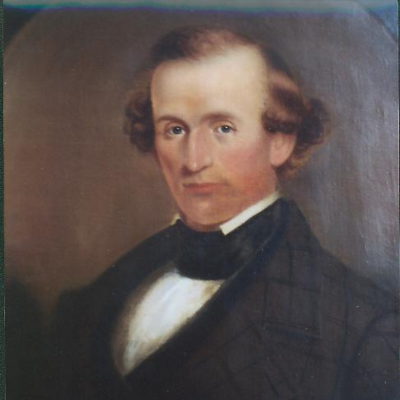
Undersheriff Osman Steele (1810-1845) who was shot and killed while presiding over the sale of property in Andes during the Anti-Rent War
Becoming a Tourist Attraction
According to the Wall Street Journal, U.S. cemeteries have undertaken a variety of non-traditional activities in recent years to attract new visitors. For example, Albany Rural Cemetery holds an annual “Cars and Crypts” event, which combines a classic car show with tours of the cemetery. Oakland Cemetery in Atlanta held a Day of the Dead festival, which drew 12,000 people. Green-Wood Cemetery staged a performance of the experimental chamber opera “Morning//Mourning” in the cemetery’s catacombs. Bellefontaine Cemetery in St. Louis, the permanent home of brewers Eberhard Anheuser and Adolphus Busch, hosts several “Beer Barons” events each year.
Many cemeteries across the country now host their own tours, concerts, historical reenactments and other events. This, in turn, has helped them to become popular destinations for visitors. Over the next few years, our Friends group expects to debut a variety of interesting events not typically associated with cemeteries to introduce the public to Woodland Cemetery, the many interesting people buried here and its place in Delaware County history. Stay tuned!
This article was adapted from an earlier version published in “Elegy,” the newsletter of the Friends of Albany Rural Cemetery.
Among Friends
Insights on coping with grief, thoughtful book recommendations, and reflections on loss, remembrance, and the ways we make meaning and stay connected.
This Is Going to Sound Crazy…
By Daryl Kovalich, LMSW
When I tell people I work as a Grief Counselor, they often ask, “How can you do that all day? It must be so difficult.” I get it. We usually associate grief with heavy feelings like sorrow, heartache, and longing. These are normal responses to death, and so are some of the “messier” emotions we don’t like to talk about, such as fear, regret, and even anger. But feelings of loss are only one facet of grief, and there are so many more to explore.
What if we also allowed ourselves to see grief as an expression of love? In a world that pressures us to “let go” and “move on,” healing through grief can be a time when we learn how to “hold on” to that love in new ways. Our love doesn’t die when the people in our lives leave their bodies for the spirit world. Why should our experience of grief be limited to what is no longer here?
I like to think of love as a powerful form of energy. In physics, energy cannot be created or destroyed; it simply changes forms. I believe love is the same. One path for healing through grief is opening ourselves up to the new forms this love takes. As we learn to live in a world without our departed, we discover new ways to remain connected to them. These “continuing bonds” are more than just wishful thinking. They are intimate expressions of love, rooted in the human capacity to keep our loved ones and ancestors close.
Sometimes, these connections take the form of common signs and symbols, like seeing a cardinal and thinking of someone special. Other times, they are deeply personal and show up in unexpected ways.
Some of my favorite moments as a Grief Counselor are when clients say, “This is going to sound crazy, but…” and then complete the sentence with a unique sign of their loved one. Like all the televisions in a house turning on to the same channel at the same time. Or a squirrel jumping onto the hood of a car exactly when the driver asked her father to show he was close by.
There are so many more examples I could share, but what’s more important is how your love endures. So give yourself permission to recognize those connections when they show up. When you feel your loved one next to you, hear a song at just the right moment, or see a cardinal land in front of you, don’t talk yourself out of it. Don’t call it a coincidence. Just stop for a second, take a breath, and allow yourself to hold on.
Daryl Kovalich, LMSW, lives in Delhi and is the Bereavement Coordinator for Helios Care, the nonprofit hospice serving Delaware, Otsego, and Schoharie Counties.
What Recipe Would You Like to Be Remembered By?
By Emily Helck, Friend of Woodland Cemetery

TO DIE FOR: A COOKBOOK OF GRAVESTONE RECIPES
By Rosie Grant
HarperCollins
ISBN: 9780063424401
Available at The Lost Bookshop, Delhi
In To Die For: A Cookbook of Gravestone Recipes, author Rosie Grant poses the question: What recipe would you like to be remembered by? Or: what is the dish you choose to nurture the future with?
Grant, an archivist, traveled to cemeteries across the nation documenting and recreating cherished recipes that are inscribed at gravesites. According to Grant, the more than 40 entries in the catalog “aren’t just instructions for food. They’re stories…”
Recipes are organized by type—gravestone recipes tend to favor the sweet, so there are multiple categories for the desserts which encompass most of the book—and each gravestone recipe is prefaced by a profile of its author. Anyone who’s written an obituary for a friend or family member knows the challenge of this particular form: how to capture an entire life in a few hundred words? Using the recipe as a focusing device, Grant paints a heartfelt picture of each subject.
In the introductory pages, Grant offers the reader ways to document her own family food history. Her expansive and thought-provoking questions are designed to tease out the reader’s food heritage. I appreciated these questions—to be honest, I felt a bit sad reading the book at first. Both my mother and grandmother were phenomenal cooks who also never wrote anything down, or even really made their dishes the same exact way twice. Growing up a picky eater, I missed out on many of my grandmother’s best dishes, but Grant’s evocative questions encouraged me to think deeply and expansively about food traditions and memories. Each day after coming home from school, I’d open the fridge at my grandma’s house to be greeted with, in my memory at least, rows of perfect parfait glasses of chocolate pudding or Jell-o (sometimes striped with different flavors!), which I would enjoy while watching reruns of The Golden Girls. Humble? Yes. Would it qualify for a gravestone recipe? I think also yes.
To Die For: A Cookbook of Gravestone Recipes is an excellent tool for understanding both American home-cook history, and your own family food legacy.
Stories Beneath the Stones
Explore the lives of those buried here—ordinary and extraordinary alike.
A Delaware County Scandal: The Rise and Fall of Judge Isaac Horton Maynard
By Kevin Jack — Friend of Woodland Cemetery
More than 140 people have served as judges on the Court of Appeals, New York’s highest court, since its establishment in 1847. Past judges include such legal luminaries as Benjamin Cardozo, who went on to serve on the U.S. Supreme Court, and Judith Kaye, the first woman named to the state’s high court.
In contrast, Isaac Horton Maynard of Delaware County, who served briefly on the Court of Appeals in 1892-93, is notorious rather than famous. According to the Historical Society of the New York Courts, we remember him “more for the questionable conduct that allegedly won him appointment to the Court than for his decisions or comportment on the bench.”
Early Life and Education
Isaac H. Maynard was born on April 9, 1838, in Bovina, the youngest of the five children of Isaac and Jane (Falconer) Maynard. Young Isaac completed his early education at Stamford Seminary and in 1858 matriculated at Amherst College in Massachusetts. Graduating in 1862, Maynard was class valedictorian and a member of Phi Beta Kappa.
Isaac then went on to study law with William Murray (1820-1887) of Delhi. Murray served successively as Delaware County DA, County Judge, and Justice of the NYS Supreme Court.
In 1865, Maynard settled in Stamford, where he practiced law and became very active in civic affairs. While in Stamford, he formed the law partnership of Gilbert & Maynard with his cousin, F. R. Gilbert.
Maynard had many notable accomplishments. He was elected as supervisor, secured the incorporation of the village of Stamford in 1870, authored its charter, served as village president for a decade, served as president of the Board of Supervisors of Delaware County, and was the first president of the local school board. In addition, he helped to found the National Bank of Stamford in 1882 and served as a bank director until the end of his life.
Family Life
Isaac married Margaret Maxwell Marvine (1840–1926) of Delhi on July 28, 1871. That year, Maynard also bought 23 acres and built a 45-room house on South Delaware Street in Stamford.
The Maynards had one daughter, Frances (1875-1943). On February 26, 1903, she married David Ford of Georgia in Manhattan. The Fords had three children: Isaac (1907-2003), Louise (1909-1949) and Lucy (1915-1989).
Margaret came from a well-to-do family. Her father was Charles A. Marvine, Sr. (1804-1874), the long-serving president of the Delaware National Bank in Delhi. Her mother, Frances Foote Marvine (1809-1891), was a member of the locally prominent Foote family. The clan included Ebenezer Foote (1756-1829), Delhi’s founder and “The Great Mogul,” and his son, Charles Augustus Foote (1785-1828), a lawyer and a U.S. congressman who practiced in Delhi. Both Ebenezer and Charles are buried in the family cemetery at their estate, Arbor Hill, in Delhi.
Political Life Calls
Isaac Maynard was elected to the NYS Assembly as a Democrat, representing Delaware County in 1876 and 1877. In the fall of 1877, he was elected Delaware County judge and surrogate, serving until the end of 1883.
In 1883, the Democrats selected Maynard to run on their ticket for Secretary of State of New York. They did this largely at the behest of Daniel Manning of Albany, who went on to become U.S. Treasury Secretary under Democratic President Grover Cleveland. Maynard, who was defeated by incumbent Republican Joseph Carr of Troy, was the only Democrat to lose statewide office that year. Some observers cited his pro-temperance stance for his loss. Maynard was subsequently appointed as First Deputy to newly elected NYS Attorney General Denis O’Brien.
In June 1885, Maynard resigned his state post and moved to Washinton, D.C. to become the second comptroller of the U.S. Treasury, working under Manning in the Cleveland administration. When Maynard started at Treasury, his office had a two-year backlog. When he left to become Assistant Secretary of the U.S. Treasury in April 1887, it was up to date.
As Assistant Secretary, Maynard oversaw many far-flung government bureaus, including the Customs Service, Internal Revenue Service, and the Lighthouse Board. With the election of Republican President Benjamin Harrison in 1888, Maynard resigned his Treasury position in April 1889.
NYS Governor David B. Hill, a Democrat, appointed Maynard in May 1889 to a special committee charged with revising the general laws of the state. The following January, Maynard was again appointed as First Deputy Attorney General, this time serving under NYS Attorney General Charles F. Tabor. As noted by the Historical Society of the New York Courts, “(Maynard’s) tenure in this post indelibly colored the remainder of his public life.”
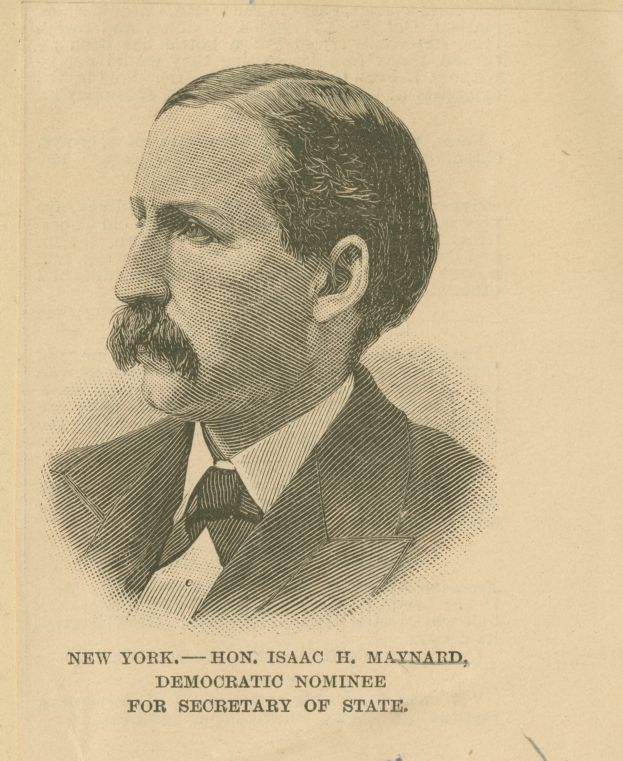
Sketch of Isaac M. Maynard, 1883 election poster
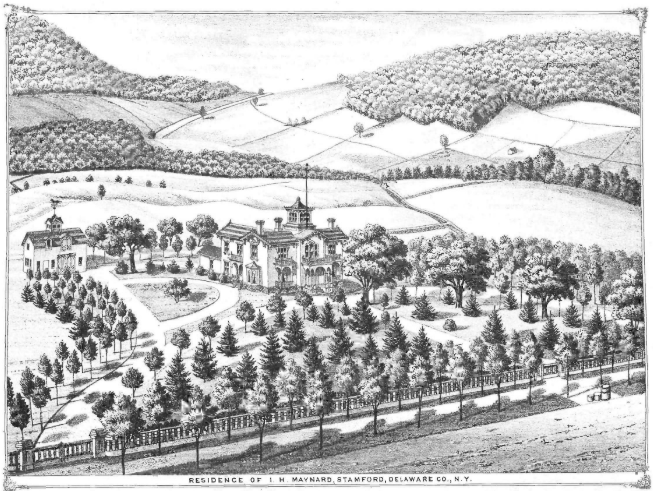
Residence of Isaac H. Maynard in Stamford

Colorized photo of Isaac H. Maynard as a young man
The Dutchess County Steal
In the fall of 1891, control of the NYS Senate hinged on four seats, including the 15th District in Dutchess County. The stakes were high as the state legislature was scheduled to take up reapportionment in 1892. While the Republican candidate won the 15th District, 31 votes were contested by the Democrats. The County Board of Canvassers threw the votes out, but the case went up through the court system. The Court of Appeals ordered the votes to be counted, and the corrected results mailed to Albany. However, Maynard had physically removed the ballots favorable to the Republican candidate from the State Comptroller’s Office, and the Democratic candidate was declared elected. This tipped the balance in the NYS Senate.
However, the details of this case came out within a few months, damaging Maynard’s reputation. For example, a March 24, 1892, editorial in the New York Times reported that up until the ballot scandal, Maynard was looked upon as a “lawyer beyond reproach.” However, after he stole the Republican ballots, while “acting as a tool” of then-Governor Hill, “Maynard the respectable became Maynard the disreputable.”
Judge Maynard
In January 1892, Democratic NYS Governor Roswell P. Flower appointed Maynard as an Associate Justice to fill a vacancy on the Court of Appeals. The New York Times characterized Maynard’s appointment as a quid pro quo for his involvement in the “Dutchess County Steal.” The New York City Bar Association launched an investigation and declared Maynard “unfit” for the judiciary.
Maynard stood for election in November 1893. In what was described as “one of the most remarkable judiciary races in (New York) State history,” Maynard’s opponent, Edward T. Bartlett, was elected by an unprecedented 100,000 vote majority. Bartlett made the “Dutchess County Steal” the focus of his campaign, and his defeat of Maynard was regarded as “a triumph for a pure judiciary.”
Final Years
Isaac H. Maynard died suddenly from heart trouble at the age of 58 in his room at the Kenmore Hotel in Albany on June 13, 1896. His death occurred less than three years after he lost his last election. He was alone in his room at the time of his death.
Maynard’s funeral was held at the First Presbyterian Church in Delhi with most members of the county’s bar in attendance. Judge Maynard was interred in Lot 308 of Woodland Cemetery in Delhi. He lies at rest next to his wife Margaret, who passed in 1926, and his daughter Frances, who died in 1943. Margaret’s parents, Charles A. and Frances F. Marvine, and several other family members are also interred in Lot 308.
Author’s note: I wish to thank David Fairbanks Ford, the great-great-grandson of Judge Isaac H. Maynard, for his insights and kind assistance with this article.
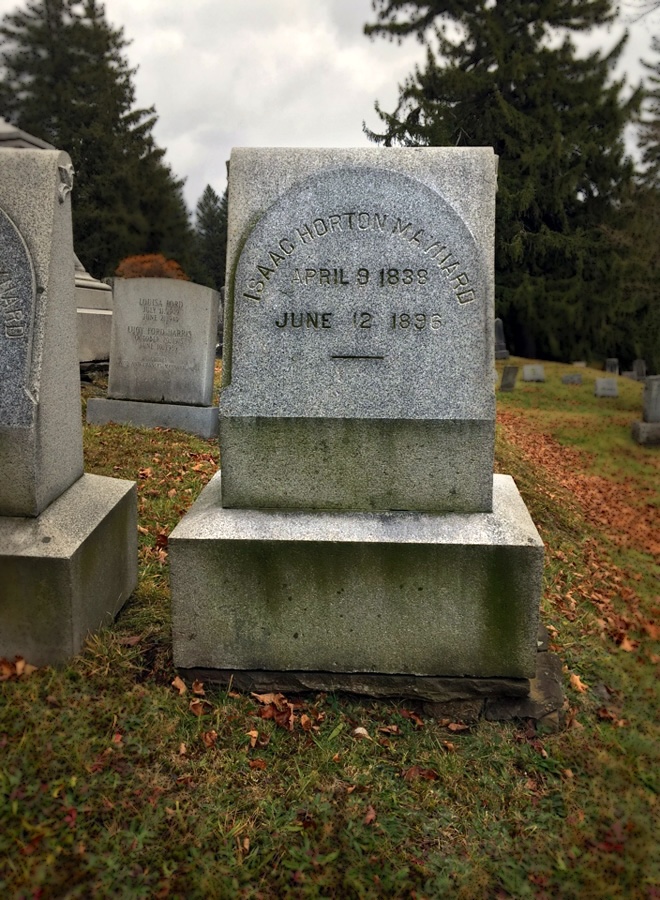
Isaac H. Maynard’s grave, Lot 308, Woodland Cemetery (Photo courtesy of David Fairbanks Ford)
Tending Woodland
Ways to support Woodland—through giving, volunteering, and staying connected—as well as updates on the projects and people helping to preserve it.
Planned Giving: Preservation as Legacy
By Janet Schwengber — Board of Directors, Friends of Woodland Cemetery
Woodland no longer operates under the “perpetual care” model it once relied on—today, its upkeep depends on burial plot sales, service fees, and the generosity of donations
Woodland Cemetery, nestled in the heart of Delhi, has stood as a symbol of the town’s rich history since its establishment in 1845. This historic cemetery reflects the community’s dedication to preserving the past while honoring those laid to rest. However, like many cemeteries today, Woodland no longer operates under the “perpetual care” model it once relied on, where long-term maintenance was guaranteed. Now, the cemetery’s only income comes from the sale of burial plots and fees for burials.
Over the years, rising costs for maintenance—including mowing, tree care, road repairs, and digging—have put increasing strain on Woodland Cemetery’s limited financial resources. If these funds run out, the Town of Delhi, with assistance from the state, will take over mowing, but only twice a year. Furthermore, no new burial plots would be sold, and only current lot holders would be eligible for burials.
To ensure the future of this historic resting place, the Friends of Woodland was established this year as a 501(c)(3) nonprofit. The group’s mission is to raise funds and provide strategic support to the Cemetery Association. These donations help the Cemetery Board maintain the grounds and ensure they remain open for future burials.
Keeping Woodland Cemetery in good condition requires community support. For those 72 or older with IRA investments, there is an opportunity to support Woodland Cemetery while also receiving a tax benefit. Each year, individuals in this category are required to take a Required Minimum Distribution (RMD) from their retirement accounts, which is typically subject to taxes. However, RMDs can be directed to a 501(c)(3) charity like Friends of Woodland without incurring taxes. This can be a significant source of funding for the cemetery, and donors benefit from avoiding taxes on these withdrawals.
There are also other ways to support Woodland Cemetery through planned giving. Planned gifts can help the cemetery’s endowment, cover ongoing expenses, and support preservation efforts. Here are a few options:
- Bequests: Including a bequest in your will is a simple way to support the cemetery, and the donation is not subject to estate tax.
- Charitable Gift Annuities or Trusts: These can provide income for you or a family member while benefiting the cemetery.
- Beneficiary Designations: Naming the cemetery as a beneficiary of your IRA or life insurance policy can also create income for you or your family while supporting Woodland.
If you are able, please consider contributing your RMD or making a planned gift to Friends of Woodland Cemetery. Your support will help preserve this historic landmark for future generations.
To learn more about Planned Giving, visit: www.woodlandcemeterydelhi.org/planned-giving or email friends@woodlandcemeterydelhi.org.
Planting for The Future
By Jess Hamilton — Trustee, Woodland Cemetery Association
This spring, Woodland Cemetery is planting native trees and shrubs along the cemetery’s edges to restore a natural buffer; softening road noise and views, and bringing back the sense of quiet enclosure that makes this place special.
Our planting includes 70 whips and seedlings: white pine, white spruce, white birch, elderberry, black chokeberry, red osier dogwood, and American hazelnut with support from the Delaware County Soil and Water Conservation District. All are native to this region and well-suited to Delaware County’s soils and climate. Many of these species provide food and shelter for birds and pollinators, and over time they’ll grow into a layered edge that supports a whole community of wildlife.
We’re also planning to convert portions of the maintained turf to native meadow plantings in the coming years; reducing mowing, controlling erosion, and creating habitat for the bees, birds, and butterflies that belong here as much as we do. A cemetery is a place where we come to remember that life is part of something larger. It seemed right to let the landscape reflect that.
In the meantime, if you’d like to try some of these plants at home, elderberry and red osier dogwood are both easy to establish, beautiful in every season, and beloved by birds. Little bluestem grass is another favorite, it turns a warm copper in fall and holds its structure through winter.

Red Osier Dogwood
Remembering Frank Bovee
1934-2022
Mention the name “Frank Bovee” to Woodland Cemetery Trustees, past and present, and you’ll hear things like: “The cemetery is measured in Frank’s feet” or “Frank literally knew where all the bodies are buried.”
For those new to the Woodland Cemetery community (or new to Delhi), Frank Bovee served as Superintendent of Woodland for more than 40 years, quietly tending to residents and the records behind them.
While Frank passed away in 2022, his work continues to define Woodland today. This June, Woodland Cemetery will honor Frank with a commemorative plaque and ceremony in recognition of his long service.